

The Cyber Security and Resilience Bill: what it means if you outsource your IT
Once it’s passed and in force, the Cyber Security and Resilience Bill will bring medium and large managed IT providers under UK cyber security law for the first time. If you outsource your IT, your provider will have to manage security risks, report significant incidents within 24 hours and tell you if you’re affected. You keep your own responsibilities.
Where has the Bill got to?
The Bill finished its Report Stage in the House of Lords on 26 October 2026, and Third Reading is scheduled for Monday 2 November. Peers defeated the government in two votes, adding two changes that MPs will need to consider before Royal Assent. Most of the detailed duties will then arrive through secondary legislation.
According to UK Parliament, the two amendments agreed on 26 October require the government to review how well the Network and Information Systems (NIS) regime works within twelve months, and to keep a register of state actors that pose a threat to UK cyber security. An amendment on reporting incidents involving frontier AI models was voted down.
None of this creates a duty for anyone yet. The government’s factsheet on managed service providers says the provider rules will be brought into force by secondary legislation after Royal Assent, and providers will then have three months to register.
Which IT providers will the Bill cover?
Medium and large managed service providers: firms that manage a customer’s IT on an ongoing basis by connecting to its systems, on site or remotely. Small and micro providers are exempt from the main duties, although a regulator can still designate one as a critical supplier. Software sellers and one-off installers are out of scope.
The government’s examples of a managed service include:
- remote IT support and helpdesks;
- managing email, applications and IT infrastructure;
- backing up customer data and monitoring systems for security or device health;
- managing routers, switches and firewalls;
- managed security services, such as a security operations centre;
- ongoing management of a cloud service.
Providers of operational technology (OT) with no wider IT management are not covered by this part of the Bill. An IT firm that remotely manages the IT systems used to monitor OT would be.
What will your IT provider have to do?
| Duty | What it means for you |
|---|---|
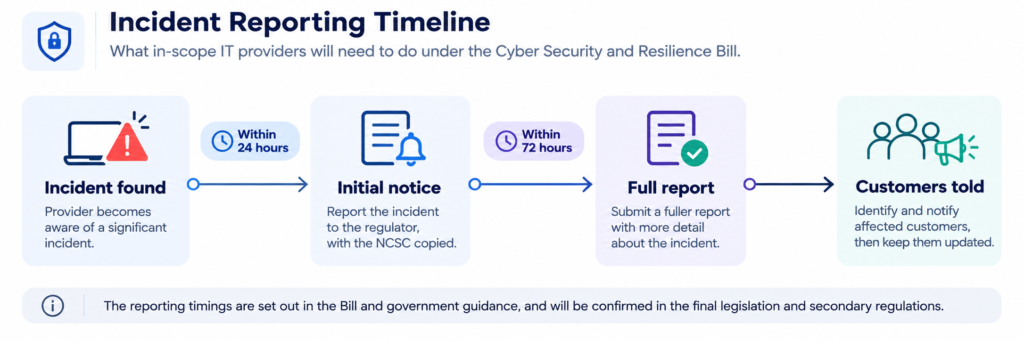
| Initial incident notification within 24 hours, full report within 72 hours, with the NCSC copied | Your provider has a legal clock running from the moment it becomes aware of a significant incident |
| Identify and notify customers likely to be affected, then keep them updated | You should hear from your provider, not from the news |
| Appropriate and proportionate security measures | The detail will come in secondary legislation, which the government says it will consult on |
| Fines of up to £17 million or 4% of worldwide turnover, whichever is higher, for more serious breaches | That’s a strong reason for providers to get this right |
The reporting timings are set out in the government’s incident reporting factsheet and in the Bill as amended on Report, and the penalty bands in the enforcement factsheet. Check the timings against the final text once the Bill is passed.
Does the Bill make your provider responsible for your security?
No. The Bill puts duties on the provider for the systems it relies on to serve you. It doesn’t take accountability off your own board. On 20 October 2026 the Information Commission (formerly the ICO) reprimanded both an IT provider and its client over the same ransomware attack, which shows how regulators already think about shared responsibility.
According to the Information Commission, attackers got in on 1 November 2024 through a test account called ‘Test2’ that had existed for more than 12 years, protected by the password ‘Password1’. Personal information about 3,300 people was taken, the majority of whom were children.
The provider, Ogi Networks, had created the account and didn’t regularly audit the accounts it had set up. The client, Data Cymru, had no contract with it containing the legally required data protection terms, and hadn’t clearly documented how the provider’s Active Directory services would be delivered, monitored or audited. Its Head of Investigations put it simply: “The responsibility for these failures did not sit with one organisation alone.”
These were reprimands under UK GDPR, not the new Bill, but the lesson carries across. Outsourcing the work doesn’t outsource the risk.
What should you ask your IT provider now?
Ask whether they expect to be covered by the Bill, how they would tell you about an incident, and who owns each security control in your contract. None of this needs the law to be in force.
It’s also a gap for many firms. The government’s Cyber Security Breaches Survey 2025/2026 found that 48% of UK businesses use an external cyber security provider, but only 15% formally review the cyber risks posed by their immediate suppliers. Among medium-sized businesses (50 to 249 staff), 30% carry out that supplier review.
Six questions worth asking:
- Do you expect to be a relevant managed service provider under the Bill, and how are you preparing?
- If you had a significant incident, how and how quickly would you tell us, and who would call whom?
- Which accounts have you created on our systems, and when were they last reviewed?
- Is multi-factor authentication on every route you use to reach our network?
- Does our contract say who delivers, monitors and audits each security control, and does it include the data processing terms the law requires?
- What will you need from us during an incident, such as out-of-hours contacts?
What if your business supplies essential services?
Regulators will be able to designate critical suppliers to essential, digital and managed services, including small firms, where an incident at the supplier could cause significant disruption to the economy or daily life. A designated supplier would face cyber security requirements, inspections and fines.
The government’s critical suppliers factsheet says a supplier must provide goods or services directly to a regulated organisation, and the regulator must judge that an incident could cause significant disruption.
Most manufacturers won’t be designated. If you supply energy, water, health or transport operators directly, expect more security questions from those customers either way.
Key takeaways
- The Bill will bring medium and large managed IT providers into UK cyber security law once it’s passed and in force.
- Providers in scope will have to report significant incidents within 24 hours and tell affected customers.
- Your own accountability stays with you. In one recent case, the regulator held both sides responsible.
- Ask your provider about scope, incident communication, accounts, multi-factor authentication and contract responsibilities now.
- Regulators will be able to designate critical suppliers, including smaller firms, that serve essential services.
FAQ
When will the Cyber Security and Resilience Bill become law?
Not yet. As of 30 October 2026 the Bill is in the House of Lords, with Third Reading scheduled for 2 November. MPs then consider the Lords’ amendments before Royal Assent. The managed service provider duties start through secondary legislation after that, and no commencement date has been published.
Is my IT provider covered by the Bill?
Probably, if it is a medium or large business that manages your IT on an ongoing basis by connecting to your systems. That includes helpdesk support, infrastructure and cloud management, backups, monitoring and managed security. Small and micro providers are exempt from the main duties, and one-off installers and software sellers are out of scope.
Will my business have new duties under the Bill?
Only if you are an operator of essential services, a relevant digital or managed service provider, a data centre, a large load controller or a designated critical supplier. Most businesses that buy IT services won’t have new duties under the Bill. Existing UK GDPR duties, including reporting personal data breaches, still apply.
What are the fines under the Cyber Security and Resilience Bill?
The government’s enforcement factsheet sets two bands. More serious breaches carry fines of up to £17 million or 4% of worldwide turnover, whichever is higher. Less serious breaches carry up to £10 million or 2% of worldwide turnover, whichever is higher. The definition of turnover will be set in secondary legislation.
What should you do next?
Nobody can promise an incident will never happen. What matters is that you and your provider both know who does what when it does. TekXera manages IT and cyber security for UK businesses. If you’d like to talk through how your current IT arrangements handle incidents and access, get in touch.